
Cancer and Exercise
What does an exercise physiologist actually do for someone going through cancer treatment?
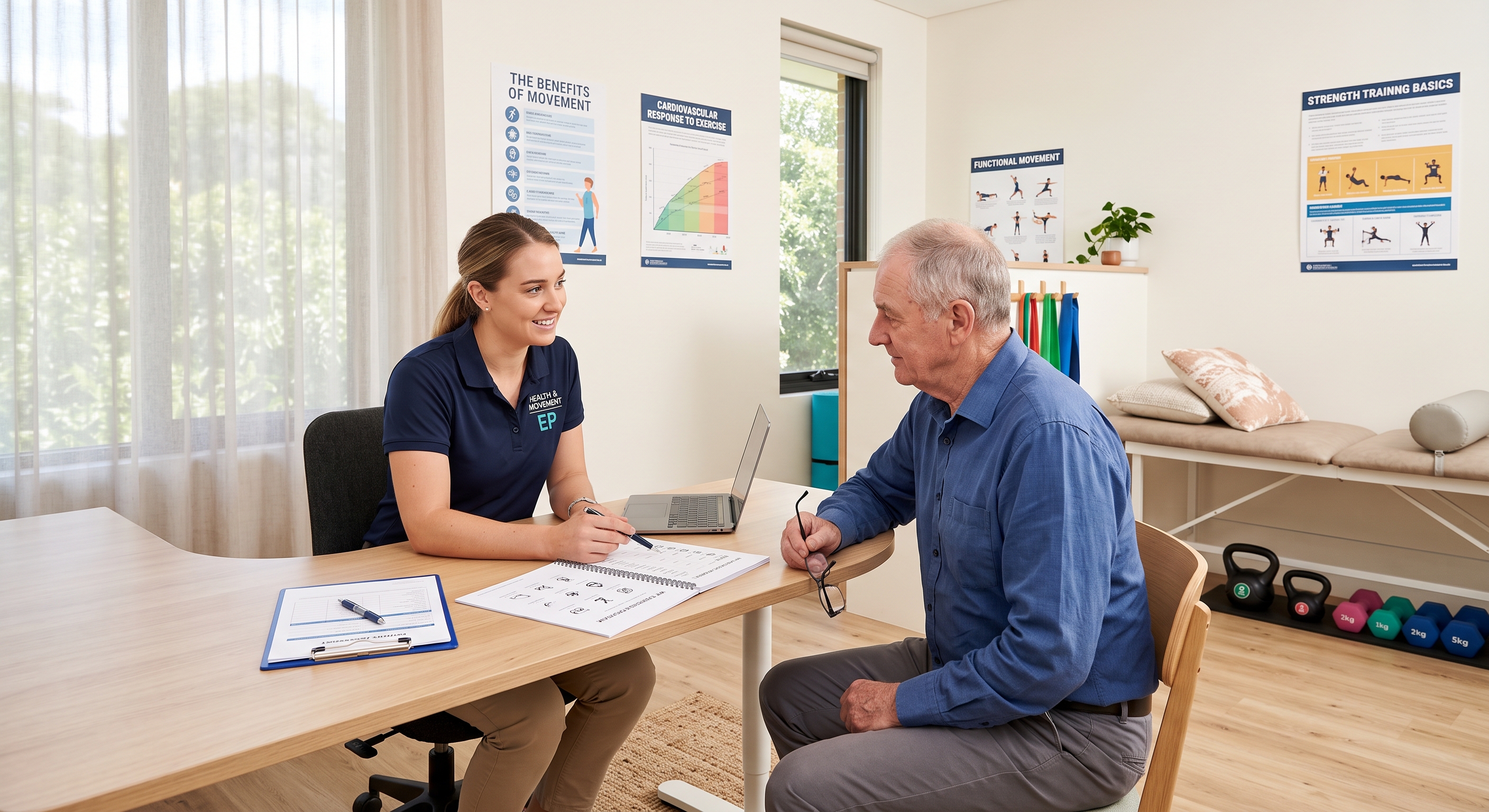
You know exercise will be helpful during your treatment, you’ve seen something in the news, spoke to someone who has gone through treatment, or you've read our article “Why is exercise during cancer treatment helpful?” and you are keen to start.
But how do you actually do it? What do you do, and when do you do it?
I am a Clinical Exercise Physiologist, and for over 10 years, I have worked with individuals at various stages of their cancer journey and helped them use exercise as a tool.
In this article, I will explain what a Clinical Exercise Physiologist is, what happens when you see one, and what they're doing behind the scenes to help you.
What a Clinical Exercise Physiologist is
A Clinical Exercise Physiologist (CEP) is a healthcare professional who uses exercise as a clinical treatment for people with complex or long-term conditions. The aim is to help you manage your health or treatment with exercise.
The profession's own progress report describes CEPs as qualified to "screen and triage, complete functional assessments, prescribe and deliver safe and effective exercise." Cancer is one of nine condition areas in the scope of practice, alongside cardiovascular, respiratory, neurological, metabolic and musculoskeletal conditions.
UK CEPs work in NHS cardiac rehabilitation, pulmonary rehabilitation and cancer services, and across the private practice sector. The registration sits with the Academy for Healthcare Science, on a register accredited by the Professional Standards Authority. This register a voluntary register, not statutory regulation. "Clinical Exercise Physiologist" is not yet a legally protected title in the UK, which is exactly why we check each practitioners registration.
A common misconception is that a CEP is a personal trainer; although on the surface it looks like we do a similar role, we have different training and skill sets.
Where a CEP sits alongside your oncology team and your physiotherapist
Your oncology team runs your treatment, including your oncologist, surgeons, and nurse. If you have surgery, you may see a physiotherapist in the first 0-4 weeks post-surgery. CEPs have a different role from your physio.
This is a quote from The Chartered Society of Physiotherapy, which runs a project on this called Collaborate, don't compete. Its position is that CEPs "specialise in the prescription and delivery of evidence-based exercise interventions" across conditions from prevention through to rehabilitation and long-term management, that "the scope of practice of a UK registered CEP is not the same as a physiotherapist," and that the demand for clinical exercise "cannot be met by expanding the physiotherapy workforce alone."
Different points on the pathway, with different training, you may see a physiotherapist for a specific post-surgical problem, for example, treatment for a shoulder after breast cancer surgery. A CEP looks at your physical capacity across the length of your treatment.
What happens in a first appointment
Your treatment history. Your diagnosis, what your treatment has looked like so far and what's upcoming and when, your medications, your surgeries and their dates, recent bloods if you have them and anything else you're managing, previous injuries, high blood pressure, asthma, all important and won’t have gone away because of your new diagnosis.
A screening conversation. This is our risk-stratification step, and it helps decide the direction of your programme. For example, a CEP may want to check with your oncology team or your surgeon before starting. The established international guidance sets out exactly this kind of triage, and a CEP will work through this carefully.
Baseline measures. Usually simple, functional things, and it will entirely depend on the person in front of them, for example, how far you can walk in a set time, how many times you can stand from a chair, grip strength, balance, how your body responds to gentle effort. These tests are not pass or fail, but a moment in time; they exist so that in six weeks there's something to compare against, and so that if something is changing, it gets noticed early.
Arguably the most important part: what you want to be able to do.** Although your goals may change over time, it’s good to have something to reference back to, and it could be something like getting up the stairs without stopping, carrying your own shopping, staying in work through treatment, or walking your daughter down the aisle in October. It helps us understand what is important to you.
How your programme is built around your treatment
Cancer treatment has ups and downs, and so will how you feel during it. Typically, chemotherapy runs in cycles; often, people have a predictable pattern within each one, accumulating in something called your Nadir point. This is the lowest point your blood cell count reaches after treatment. Energy levels may be at their lowest, and you could be more susceptible to infection and illness.
Radiotherapy fatigue often accumulates across your treatment cycle. Surgery has a recovery timeline with restrictions attached to it. Hormone therapy can affect bone and muscle over months.
Your programme will be built around these dates and treatment plans. The international consensus guidance is explicit that when someone is on active treatment, working closely with the oncology team is crucial because treatment plans change.
What a session actually looks like
Sessions typically run 30 to 60 minutes, one-to-one, and/or sometimes in small groups. Some CEPs work from a clinic room, some can come to you, some work online, and many do a mix. You personally may want a specific structure or something more flexible. Research consistently shows supervised programmes producing greater improvements in mood, physical function, and quality of life than programmes people do entirely alone, and routine helpsto create consistency.
Equipment needed depends on you, what you have available and your current ability, bodyweight movements, resistance bands, dumbbells, a chair, a bike, or a corridor to walk can all be part of the equipment list.
Intensity will be based on how you are feeling on that day. Macmillan has good guidance: at the end of an activity, you should feel energised, not exhausted. Some days that's a full session, some days it's ten minutes of movement and a conversation about why this week has been hard.
—
How it changes as you go
The work isn't the same at every stage, which is why this is a relationship rather than a programme.
Before treatment — prehabilitation. Between your diagnosis and surgery or the start of treatment are a window, and the aim is to go into treatment with more in reserve. → What is prehab, and how can it help me before my surgery?
During treatment. Holding on to strength and function, manage fatigue where possible, this is the outcome with the strongest evidence behind it. → Why is exercise during cancer treatment helpful?
After treatment. This can be a difficult time period; there can be a feeling like your safety net has gone. Building yourself back up again and understanding what the future looks like.
What your CEP is watching for
While you're working, your CEP will be monitoring you, and the list of things that change what you should be doing is long.
Your bloods. Cancer treatment can affect red cell counts, white cells and platelets. Those numbers change the intensity levels of your exercise.
Peripheral neuropathy. Numbness and altered sensation in hands and feet is common with certain chemotherapies, and it can affect balance and grip. International guidance flags neuropathy as a reason to modify a programme and to have a medical assessment first.
Bone health. Some treatments reduce bone density, and some cancers spread to bone. Where there are bone lesions and bone mets: avoid loading the affected skeletal site, and maximal strength testing on muscles acting on it.
Post-surgical restrictions. Lifting limits, wound healing, range of movement, after abdominal or chest surgery, and staging your return.
Lymphoedema and lymph node surgery. Advice here has changed, the current evidence supports progressive resistance training, started under supervision, on a "start low, progress slow" basis, rather than the avoidance that used to be recommended.
And how you're tolerating it. Guidance says the clinician should watch for early signs that training isn't being tolerated and adjust the dose; "even if this means dropping below recommended training volumes."
—
How they work with the rest of your team
Being clear about what falls outside their scope and referring when it does, asking you to check with your oncology team or surgeon where guidance says clearance is needed, and it means keeping your team informed: a summary of what was assessed, what's been prescribed, and how you're responding, so your oncology team has a clear picture.
International guidance also asks oncology clinicians to assess activity, advise on it, and refer, while also acknowledging they aren't expected to write the exercise prescription themselves.
—
How you get to see one
- You get in touch. Name, email, and phone number
- We call you. A short conversation about your current situation, what your treatment involves, and your stage, location, and session type (in-person or virtual).
- We match you. We find a Clinical Exercise Physiologist who works with cancer.
- We introduce you. You take it from there with your CEP, who confirms how they work and what it costs before anything is booked.
Some NHS trusts run good cancer exercise and prehabilitation services; you can ask your team about it directly. Provision across the UK is uneven, and many trusts can't offer it at all.
—
Common questions
Do I need a referral from my GP or oncologist? No. You can come to us directly. That said, we'd always encourage you to tell your oncology team you're starting, and there are situations where guidance says you should be medically assessed or cleared before you begin. Your CEP will identify those at your first appointment.
What does it cost? The Health Nav is free to use. Clinical Exercise Physiologists set their own fees, and your practitioner will confirm the cost with you before anything is booked.
Will my insurance cover it? UK insurers widely recognise physiotherapy; Clinical Exercise Physiology is a newer registered profession, and cover isn't standard. If you hold a policy, check directly with your insurer; some will consider it case by case, and ask your CEP what they've seen.
Do I need to be fit already? No, not at all. The exercise interventions in the research were run with people going through chemotherapy and radiotherapy. Starting from a low baseline is the normal case, not the exception.
Can I start while I'm still on treatment? Yes: that's the most common time to start. ASCO's 2022 guideline recommends aerobic and resistance exercise during treatment given with curative intent, specifically to reduce the side effects of chemotherapy. Your programme gets built around your treatment schedule rather than waiting for it to finish.
What if I have a bad week and can't do anything? Bad weeks are normal and too be expected. Programmes are adjusted around how you are, and a session that becomes a conversation and ten minutes of gentle movement is still a session.
Ready to talk to someone? Tell us about your diagnosis, where you are in treatment, and where you're based. We'll match you with a Clinical Exercise Physiologist who specialises in cancer. AHCS-registered and personally verified by our team.
→Reach out to our team to find your Clinical Exercise Physiologist
This article is general information and is not a substitute for advice from your oncology team. Always speak to them before starting or changing physical activity during cancer treatment.
Sources
- Jones H, Crozier A, George K, et al. Establishment of clinical exercise physiology as a regulated healthcare profession in the UK: a progress report. BMJ Open Sport Exerc Med. 2024;10(2):e002033. https://pmc.ncbi.nlm.nih.gov/articles/PMC11191777/
- Clinical Exercise Physiology UK (CEP-UK). AHCS Registration. https://www.clinicalexercisephysiology.org.uk/ahcs-registration
- The Chartered Society of Physiotherapy. Collaborate, don't compete — supporting the development of a Clinical Exercise Physiologist. https://www.csp.org.uk/professional-clinical/improvement-innovation/collaborate-dont-compete/supporting-development
- Campbell KL, Winters-Stone KM, Wiskemann J, et al. Exercise Guidelines for Cancer Survivors: Consensus Statement from International Multidisciplinary Roundtable. Med Sci Sports Exerc. 2019;51(11):2375–2390. https://journals.lww.com/acsm-msse/fulltext/2019/11000/exercise_guidelines_for_cancer_survivors_.23.aspx
- Ligibel JA, Bohlke K, May AM, et al. Exercise, Diet, and Weight Management During Cancer Treatment: ASCO Guideline. J Clin Oncol. 2022;40(22):2491–2507. https://pubmed.ncbi.nlm.nih.gov/35576506/
- Schmitz KH, Campbell AM, Stuiver MM, et al. Exercise is medicine in oncology: Engaging clinicians to help patients move through cancer. CA Cancer J Clin. 2019;69(6):468–484. https://acsjournals.onlinelibrary.wiley.com/doi/10.3322/caac.21579
- Macmillan Cancer Support. Being active during cancer treatment. https://www.macmillan.org.uk/cancer-information-and-support/treatment/preparing-for-treatment/physical-activity-and-cancer/during-treatment